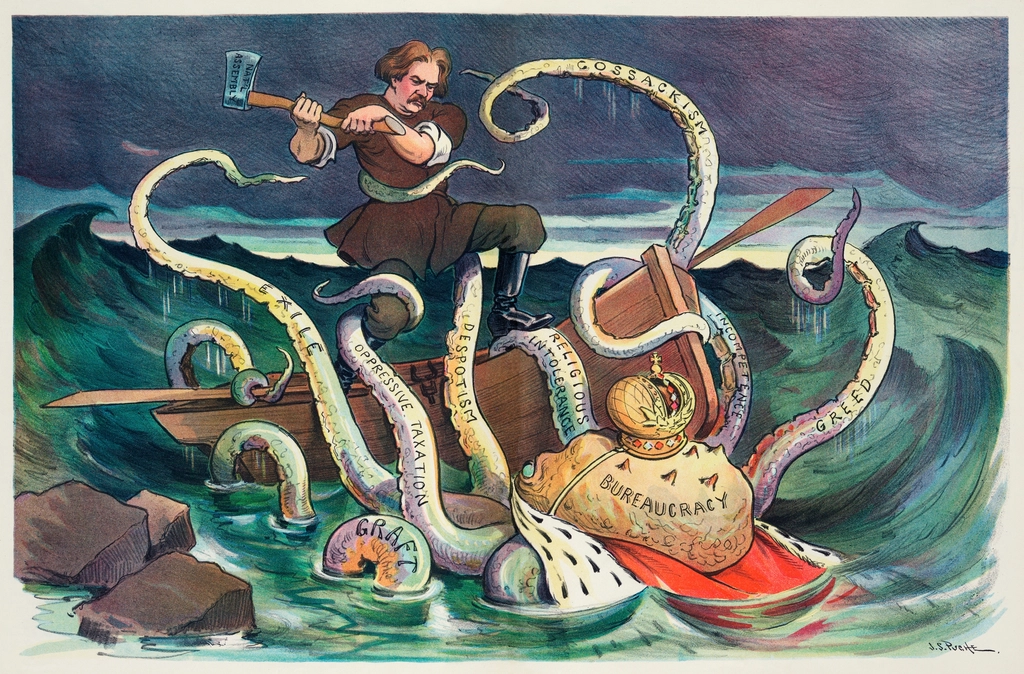
Hannah Arendt’s stark diagnosis in „On Violence“ remains unsettlingly prescient: the modern state, she argued, is fundamentally built upon and sustained by the potential for violence. This violence represents not power’s essence, but its collapse – the moment when genuine political power, rooted in collective action and consent, fails (Arendt 1970). States, as rigid bureaucratic formations, inherently resist fluid transformation. Their structures ossify, prioritizing self-preservation over functional adaptation, inevitably leading to friction and, ultimately, existential conflict. If the state is synonymous with this latent violence and structural inertia, Arendt implies, perpetual conflictivity becomes its grim shadow. Accepting this sobering proposition compels us to ask: Can we mitigate this inherent brittleness? In this vein, one provocative structural intervention emerges: imposing expiration dates on ministries and agencies, necessitating periodic renewal to tackle bureaucratic fossilization.
The Iron Cage and the Violence Within
Arendt’s framework finds deep resonance in Max Weber’s conception of the state as the entity claiming a „monopoly of the legitimate use of physical force“ (Weber 1978). For Weber, the modern state is inseparable from its bureaucratic machinery – an „iron cage“ of rationalized procedures. While designed for efficiency, this bureaucracy inevitably develops its own functional logic. Its primary drive shifts from fulfilling its original mandate towards self-perpetuation. Officials become invested in the survival and expansion of their domains, procedures calcify into rigid dogma, and responsiveness to changing societal needs diminishes (Michels 1962; Selznick 1949). This is the seedbed of Arendt’s „extreme form of power exercise“ – violence becomes the tool of last resort when the inflexible structure encounters resistance it cannot absorb or co-opt through established (but perhaps outdated or illegitimate) channels. Think of colonial administrations suppressing dissent, or authoritarian regimes maintaining control through fear – violence erupts where bureaucratic rigidity fails to manage the polity peacefully.
David Graeber, in his exploration of „Bullshit Jobs“ and bureaucratic inefficiency, further illuminates this tendency (Graeber 2018). He observes how vast swathes of administrative activity serve no discernible public good, existing primarily to justify their own existence and reinforce hierarchical structures. This self-referential reproduction is the essence of fossilization. Bureaucracies, once established, develop intricate internal ecosystems resistant to change. They generate internal metrics of success divorced from external impact, prioritize risk aversion over innovation, and cultivate cultures resistant to external scrutiny or reform. Michel Foucault’s analysis of disciplinary power adds another layer to this, showing how bureaucratic structures don’t merely administer; they actively shape subjects and realities through surveillance, classification, and disciplinary normalization (Foucault 1977; 2007). A fossilized bureaucracy thus doesn’t just fall short of adapting; it actively perpetuates outdated norms and power imbalances, becoming a source of friction itself.
The Expiration Date: Disrupting the Cycle of Self-Preservation
This is where the seemingly radical proposal of institutional sunset clauses becomes compelling. Mandating that ministries and agencies automatically expire unless explicitly renewed through a rigorous legislative and evaluative process introduces a crucial mechanism for forced reflection and potential reinvention. Its core purpose is to disrupt the automaticity of bureaucratic self-perpetuation and combat the inherent tendency towards fossilization (Crain & Tollison 1981).
- Combating Mission Creep and Redundancy: Agencies often outlive their original purpose or see their mandates expand uncontrollably. A sunset clause forces a fundamental reassessment: Does this entity still serve a vital, unique, and necessary function? Can its tasks be absorbed elsewhere, streamlined, or simply discontinued? This prevents the accumulation of bureaucratic „deadwood“ – agencies clinging to existence long after their relevance has faded, consuming resources and complicating governance.
- Mandating Evidence-Based Legitimacy: Renewal would not be automatic. It would require a public demonstration of effectiveness, efficiency, and continued relevance. Agencies would need to present data, undergo independent audits, and justify their existence to legislators and, implicitly, the public. This injects a much-needed dose of accountability and performance-based legitimacy, countering the tendency towards insular self-justification.
- Creating Space for Innovation and Adaptation: The looming expiration date creates a natural window for restructuring. Instead of minor tweaks to a crumbling edifice, it opens the possibility for fundamental redesign. Could this function be better served by a different model – a smaller agency, a cross-departmental task force, an independent commission, or even outsourced to regulated private/non-profit entities? It encourages asking not just „how can we keep going?“ but „what is the best way to achieve our defined objectives now?“
- Enabling Path Creation: Fossilized bureaucracies create immense path dependency – the high cost (real and perceived) of changing established systems locks in inefficient or outdated practices (David 1985; Pierson 2004). Sunset clauses lower this barrier by creating predictable, scheduled opportunities for systemic overhaul. The „cost of change“ is built into the political cycle. In this sense, such interventions not only mitigate path dependency but also open possibilities for path creation—the emergence of novel institutional trajectories that break with inherited routines and generate new directions for governance (Garud & Karnøe 2001; Sydow, Schreyögg, & Koch 2009). Path creation highlights how deliberate interventions can reconfigure structural constraints and carve out alternative futures.
Navigating the Pitfalls: Beyond Naive Optimism
Implementing such a system is not without significant challenges, demanding careful design:
- The Risk of Symbolic Renewal: The greatest danger is the process degenerating into a rubber-stamp exercise. Legislators, potentially swayed by powerful bureaucratic lobbies or inertia, might renew entities without genuine scrutiny. Robust, independent evaluation mechanisms and strong transparency requirements (public hearings, published review criteria, clear performance metrics) are essential safeguards.
- Instability vs. Necessary Fluidity: Critics might argue this creates harmful instability. However, the goal isn’t constant chaos or radical change, but managed evolution. The review periods should be substantial (e.g., 10-15 years), providing stability while ensuring regular, structured opportunities for reassessment. The instability caused by fossilized, unresponsive bureaucracies crashing into social change is far more consequential.
- Transition Costs and Expertise Loss: Shuttering or radically restructuring agencies incurs costs and risks losing valuable institutional knowledge. Processes for orderly wind-downs, staff redeployment, and careful documentation of essential knowledge must be integral to the sunset framework. The cost, however, must be weighed against the long-term drain of maintaining ineffective or obsolete structures.
- The „Legacy Problem“: Some state functions are truly perennial (core justice, basic defense). While their form might need review, their existence is non-negotiable. The sunset process for these would focus intensely on efficiency, structure, and adapting methods, not questioning their fundamental necessity. Clear constitutional or foundational safeguards can define these core functions.
Conclusion: Towards a Less Brittle Polity
Hannah Arendt forces us to confront the uncomfortable violence latent within the rigid structures of the state. Weber and Graeber reveal the bureaucratic machinery’s relentless drive towards self-preservation and irrelevance. Foucault shows how these structures actively shape and constrain citizens and their behaviors. Recognizing that states are prone to ossification—and to violent conflict resolution as a result—makes structural countermeasures imperative.
Institutional expiration dates are not a panacea, but a powerful procedural tool to inject dynamism into the state’s ossifying bones. By mandating periodic justification, forcing critical evaluation, and creating deliberate windows for reinvention, we can challenge the automatic reproduction of bureaucratic forms. This disrupts the path to fossilization, potentially reducing the friction that erupts when inflexible structures meet an ever-evolving world. It moves us towards a state capable of evolving with its people, less reliant on the blunt instrument of violence that Arendt so chillingly identified as the ultimate symptom of power’s failure. It is an attempt to build a state less brittle, less prone to shattering under the pressure of its own rigidity – a necessary step towards realizing a political power less dependent on its most extreme and destructive form. The goal is not the state’s demise, but its constant, conscious, and peaceful evolution.
References
Arendt, Hannah. On Violence. New York: Harcourt, 1970.
David, Paul A. “Clio and the Economics of QWERTY.” American Economic Review 75, no. 2 (1985): 332–37.
Foucault, Michel. Discipline and Punish: The Birth of the Prison. New York: Vintage, 1977.
Foucault, Michel. Security, Territory, Population: Lectures at the Collège de France 1977–1978. New York: Palgrave Macmillan, 2007.
Garud, Raghu, and Peter Karnøe. “Path Creation as a Process of Mindful Deviation.” In Path Dependence and Creation, edited by Raghu Garud and Peter Karnøe, 1–38. Mahwah, NJ: Lawrence Erlbaum, 2001.
Graeber, David. Bullshit Jobs: A Theory. New York: Simon & Schuster, 2018.
Michels, Robert. Political Parties: A Sociological Study of the Oligarchical Tendencies of Modern Democracy. New York: Free Press, 1962 [1911].
Pierson, Paul. Politics in Time: History, Institutions, and Social Analysis. Princeton: Princeton University Press, 2004.
Selznick, Philip. TVA and the Grass Roots: A Study in the Sociology of Formal Organization. Berkeley: University of California Press, 1949.
Sydow, Jörg, Georg Schreyögg, and Jochen Koch. “Organizational Path Dependence: Opening the Black Box.” Academy of Management Review 34, no. 4 (2009): 689–709.
Weber, Max. Economy and Society: An Outline of Interpretive Sociology. Edited by Guenther Roth and Claus Wittich. Berkeley: University of California Press, 1978.
Crain, W. Mark, and Robert D. Tollison. “The Executive Branch in the Sunset: An Empirical Analysis of Agency Sunset Laws.” Journal of Law and Economics 24, no. 1 (1981): 55–75.
By Vural C. Kaptan
Contact the corresponding author: https://www.linkedin.com/in/vural-kaptan/?originalSubdomain=de
Kommentar verfassen